
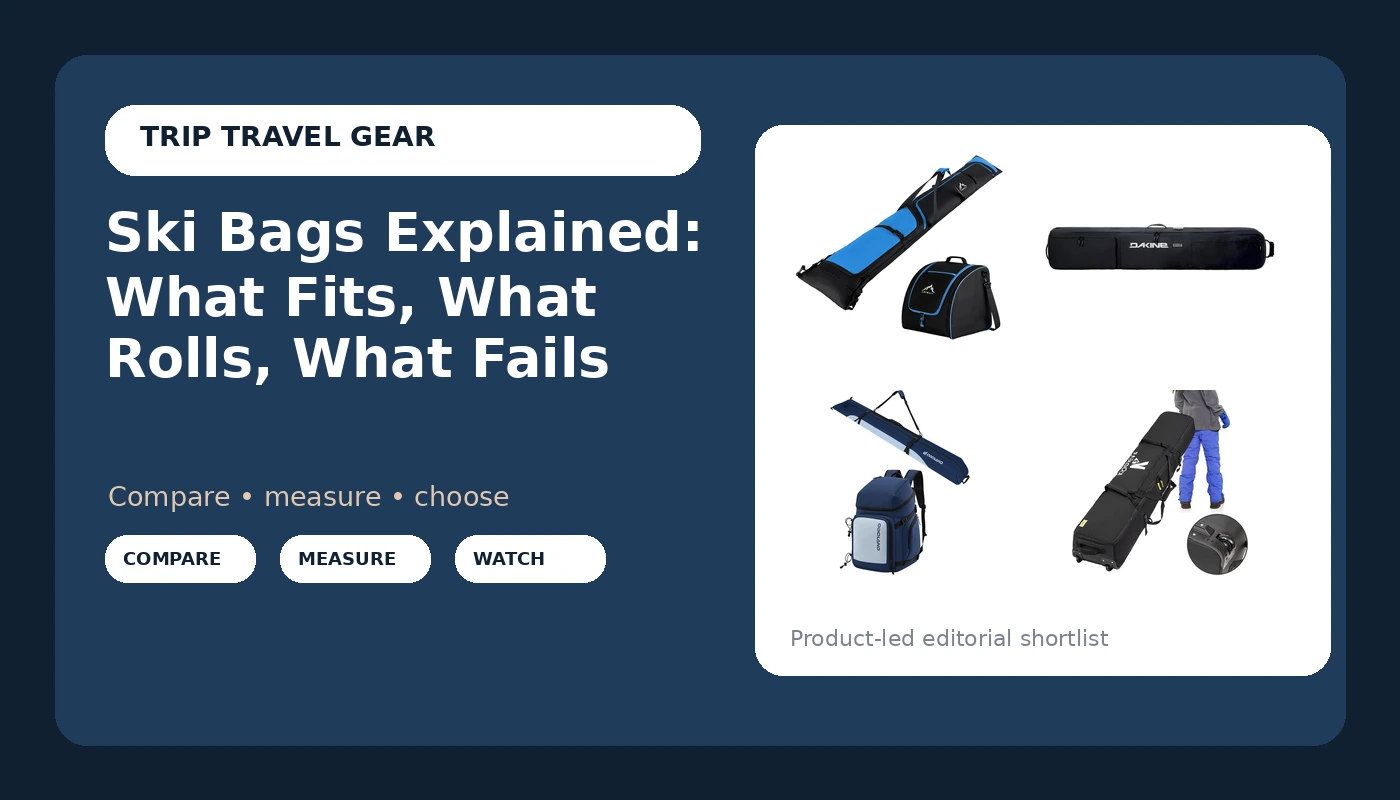
A ski bag is the one piece of winter luggage where the measurements matter more than the marketing copy. Skis are long, thin and awkward, and the bag that carries them has to survive a conveyor belt, a luggage cart and whatever happens on the ramp between the counter and the hold. Ski bags come in a handful of formats: a padded sleeve, a combo that pairs a ski sleeve with a boot bag, a wheeled single, a wheeled double. The differences between them come down to length, padding, wheels and who ends up carrying the weight. What follows is ski bags explained in the terms that actually decide a purchase: the stated length, the padding, the wheel type and the boot capacity you have to account for.
Quick answer
Buy a padded ski bag whose stated length clears your longest ski, then decide whether you want wheels, a boot compartment, or both. A combo suits anyone flying with their own boots. A wheeled double suits two people travelling together. A plain padded sleeve suits a skier who already owns a rolling duffel and just needs protection for the skis themselves. Treat any Ski Bags buying guide as a set of measurements rather than a ranking, because the right bag depends on ski length, how the bag will be checked, and whether you can carry it one-handed through a terminal.
Five useful options
The five bags here cover the formats a skier is most likely to buy: two combos, two wheeled options and one plain padded sleeve. Use this as a Ski Bags comparison of formats first and products second.
| Model | Best fit | What stands out |
|---|---|---|
| Ski Bag & Boot Bag Combo, Padded Ski Carrier | Budget two-piece setup | Ski sleeve and boot bag sold together, padded, no wheels stated |
| Dakine Fall Line Ski Roller Bag, Ski Travel Bag | Flyers who want wheels | Roller format from a snow-specific brand |
| Odoland Ski Bag and Boot Bag Combo, Padded Ski Bags for Air Travel | Checked air travel with boots | Padded combo marketed for flights |
| Rolling Double Ski Bag with Wheels for Air Travel | Two pairs, one bag | Double capacity with built-in wheels |
| Athletico Diamond Trail Padded Ski Bag – Single Ski Travel Bag to Transport Skis | Simple padded single | Single-ski sleeve, no boot bag, no wheels |
Best budget combo: Ski Bag & Boot Bag Combo, Padded Ski Carrier
This is the least expensive way into a two-piece setup among the five bags here, and that is the whole argument for it. When people ask about the best budget Ski Bags setup, the honest answer is usually a combo like this one, because the boot bag is the piece beginners forget and then buy in a resort shop at resort prices. The trade-off is that nothing in the name suggests structure or wheels, so a long walk through a parking lot or a train platform is on you. Check the stated length against your skis before ordering, and check whether the boot bag is sized for your boot size rather than assuming it.
Best roller: Dakine Fall Line Ski Roller Bag, Ski Travel Bag
Wheels are the feature that changes how a ski trip feels, because a loaded ski bag is an awkward, unbalanced thing to carry at arm's length through a check-in line. The cost of wheels is weight and one more part that can fail, and the wheel housing is exactly where soft luggage tends to give out first. Look at how the housing is attached and whether the wheels sit inside a protective shell or hang off the fabric. Ski Bags reviews tend to repeat the same complaints across brands, and the recurring ones are the telescoping handle losing a lock stage and a zipper pull separating from the slider, so read those sections specifically rather than skimming the star average.
Best combo for air travel: Odoland Ski Bag and Boot Bag Combo, Padded Ski Bags for Air Travel
"Air travel" in a listing title is not the same as a dimension that clears a specific carrier's checked-bag limit, and that distinction is worth holding onto. Airlines publish their own linear-inch and weight limits, and the numbers change, so verify with the carrier you booked rather than with the product page. A padded combo like this one is the sensible middle of the range: more protection than a bare sleeve, less hardware to break than a roller, and boots that travel in their own compartment instead of grinding against ski bases. Confirm whether the two pieces attach to each other, because a combo that separates into two loose bags is a different airport experience than one that clips together.
Best double: Rolling Double Ski Bag with Wheels for Air Travel
The case for a double is arithmetic: one checked bag instead of two, one baggage fee instead of two on carriers that charge per bag, and one thing to keep track of at the carousel. The case against it is weight. Two pairs of skis plus poles can push a double close to a common fifty-pound checked limit before you add anything else, and the bag's own hardware counts against you. Weigh it on a kitchen scale at home, packed, and do it the night before rather than at the counter. If the total lands near the limit, a single bag per person is the better plan even if it costs a second fee.
Best single sleeve: Athletico Diamond Trail Padded Ski Bag – Single Ski Travel Bag to Transport Skis
A sleeve is what Ski Bags for beginners usually should be, because it protects the expensive part, the skis, without adding hardware and weight you have not learned to need yet. It also travels well inside a larger duffel or strapped to a roof rack, which is why drivers and train travellers keep buying them. The limit is obvious: no structure means the bag takes the shape of whatever is packed around it, and a single layer of padding is not the same as a rigid tub. If your skis are new, or you fly more than once a season, the extra protection of a structured or wheeled bag is worth considering.
Prices and availability may change. Product images, names, and retailer links must be matched by verified ASIN. Do not state a current price, rating, stock status, or measured result without current evidence.
What ski bags actually protect
Padding is not there to survive the throw. It is there to keep the bag's own hardware, zipper sliders, handle rivets and wheel bolts from pressing into ski bases, and to keep sharp steel edges from cutting the fabric from the inside out. That is why a padded bag with a thin base panel fails differently from a cheap unpadded one: the edges win either way, but they win faster against thin material.
Bindings are the bulky part and the part that creates pressure points. A bag sized exactly to ski length leaves no room for bindings at the ends, so the fabric stretches and the zipper becomes the load-bearing element. Look for a stated length that clears your skis with room to spare, and treat a tight fit as a warning rather than a bargain.
The parts that fail first, in order, tend to be the zipper, the carry handle attachment, the wheel housing and the seam at the end of the bag. None of those show up in a star rating. They show up in the written complaints, which is why reading the text of Ski Bags reviews beats reading the average.
Boots deserve their own compartment for a reason that has nothing to do with organisation. They are wet, salty and heavy, and a boot bag keeps that away from ski clothing and from the inside of the ski sleeve.
The ski bags size guide: length, linear inches and weight
Length is the number that decides fit. Measure your longest ski tip to tail, flat, then add a couple of inches of clearance for bindings and for a bag that will not be stretched to the zipper stops. If the listing does not state an interior length, ask before buying; exterior length includes the end caps and tells you less than you think.
Linear inches is the number the airline enforces on checked bags: length plus width plus height. Standard checked limits are usually stated per carrier and change over time, so check the figure on your carrier's own baggage page rather than a third-party summary. Weight limits are separate, and for ski bags the weight limit is usually the binding constraint.
Also account for the bag's own weight. Wheels, a frame and heavy fabric all count against the same limit as your skis, and a double bag loaded with two pairs and poles can approach a common fifty-pound cap quickly.
One more measurement worth taking: the boot bag. Boot shells are sized in mondo point, and a boot bag that fits a 26.5 shell will not necessarily swallow a 30.5. Check the stated capacity against your own boot size.
- Measure your longest ski flat, tip to tail, and write the number down.
- Add about two inches of clearance, then compare that figure to the bag's stated interior length, not its exterior.
- Decide whether boots travel in the same purchase or in a bag you already own.
- Check your carrier's current checked-bag linear-inch and weight limits on its own site.
- Weigh the packed bag on a kitchen scale at home, then test the zipper, the handle and the wheels before you leave.
Packing and check-in habits that save the bag
- Dry the skis and scrape the edges before bagging, because wet steel in a closed bag for twelve hours is how rust starts.
- Strap the skis together or slide edge guards on, so the edges cannot saw at the padding in transit.
- Put boots in the boot bag, never loose in the ski sleeve, where they press directly on the bases.
- Put a card with your name and phone number inside the bag as well as on the outside tag, since exterior tags are the first thing to disappear.
- Do not overstuff. A bag that zips only under tension is a bag whose zipper is already failing.
Which option should you choose?
Choose the Ski Bag & Boot Bag Combo, Padded Ski Carrier when you want both pieces at the lowest cost and you are not planning to wheel the bag through an airport. Choose the Dakine Fall Line Ski Roller Bag, Ski Travel Bag when you fly often enough that wheels and a dedicated ski-travel build are worth the premium. Choose the Odoland Ski Bag and Boot Bag Combo, Padded Ski Bags for Air Travel when you want padding plus a boot compartment without paying for a roller. Choose the Rolling Double Ski Bag with Wheels for Air Travel when two people travel together and one checked bag is the goal. Choose the Athletico Diamond Trail Padded Ski Bag – Single Ski Travel Bag to Transport Skis when you already own a boot bag and a rolling duffel and only need the skis protected.
The caveat is evidence. The product names recorded here state padding, capacity and wheels, but none of them states an interior length, a padding thickness or a warranty term, and those are the numbers that decide whether a bag fits your skis and survives five seasons. Check the listing for the stated dimensions, read the written complaints about handles and zippers, and treat any list of top rated Ski Bags, including this one, as a starting point rather than a verdict.
The bottom line
The right ski bag is the one whose stated length clears your skis and whose format matches how you actually travel. Combos solve the boot problem cheaply, rollers solve the airport walk, doubles solve the second pair, and a plain padded sleeve solves protection with the least weight and fuss. Buy on the measurement, verify the airline limit with the carrier, weigh the packed bag before you leave, and read the reviews for the parts that fail rather than the score at the top.