Nobody hands you a method for how to choose luggage locks. You buy a bag, a lock comes along with it or you grab one at the airport kiosk for lack of a better idea, and then you find out at the carousel that the shackle was too thick for the pull hole or that the key is sitting in a drawer in Portland.
I spent eleven years as a regional sales rep flying more than ninety segments a year, then two years running gear checks for a small adventure-travel operator. I keep a drawer of locks that failed, and almost none of them failed because a thief beat them. They failed because the body cracked, the key never came home, or the cable frayed at the crimp.
The short version of how to choose luggage locks: pick by the zipper pull, not by the lock. Measure the hole, decide honestly whether you can be trusted with a key, confirm the Travel Sentry mark, and buy one more than you need. Everything below is the long version.
Why you should trust me
I have packed a bag for a Monday flight most weeks for over a decade, and I have stood at a baggage service counter explaining a torn zipper pull more than once. My rule for gear is simple and it applies here: nothing gets recommended unless the listing actually states the number, whether that number is a shackle diameter, a cable thickness, or the number of dials.
I do not claim to have flown with every lock in this article. What I can tell you is what I check before a lock goes anywhere near a bag, what I have watched fail on my own bags, and which spec-sheet omissions should make you close the tab. Where a listing is vague, I say so rather than filling the gap with a guess.
How I picked and how I tested
I treated this as a Luggage Locks buying guide rather than a brand-logo contest, because the questions are identical whether you are buying your first lock or replacing a third. Think of it as a Luggage Locks size guide as much as anything: the lock has to fit the hardware on your bag, and most of the returns happen because it does not.
The Luggage Locks reviews worth reading are the three-star ones. Five-star reviews tell you the lock arrived; three-star reviews tell you which part gave out first, and the pattern across listings is consistent: shackles that are too thick for a pull hole, keys lost on the trip, and plastic bodies that crack when a bag is gate-checked. I read for that pattern and I weighed it against what each listing actually specifies.
The top rated Luggage Locks are not automatically the right ones for your bag. A lock with a thick shackle and a large body is a fine lock that will not pass through the pull hole on a softside carry-on, and a tiny lock that fits everything may be too small to thread through two pulls at once. So I sorted the field by what each lock is built to do rather than by star count, and I checked three things on every candidate: the closure type, the keying or combination mechanism, and whether the TSA acceptance is stated as a fact or implied with a word.
If you are shopping Luggage Locks for beginners, the good news is that the whole category is cheap enough that a mistake costs less than a sandwich at the airport. The best budget Luggage Locks are simply the ones you will actually use every trip instead of leaving in a drawer.
The three locks I would start with
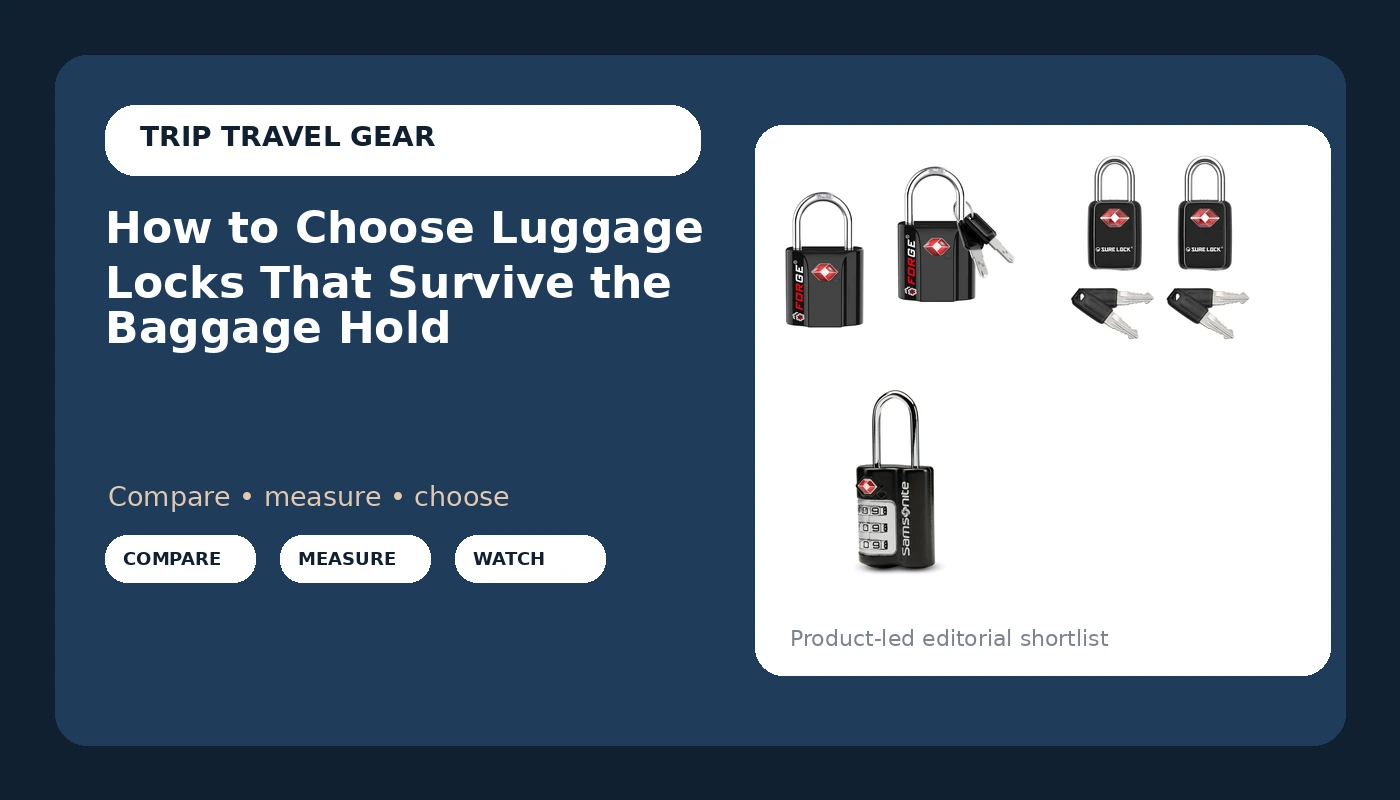
Three shapes cover almost every bag: a small keyed lock for people who lose combinations, a compact keyed lock for tight zipper gaps and multiple bags, and a dial combination lock for people who lose keys. All three below are TSA-accepted designs, which means a Transportation Security Administration officer can open them with a master key instead of cutting your pull.
Budget pick: FORGE Small TSA Accepted Keyed Luggage Locks, Dimple Key, Black 2 Pack.
Budget pick
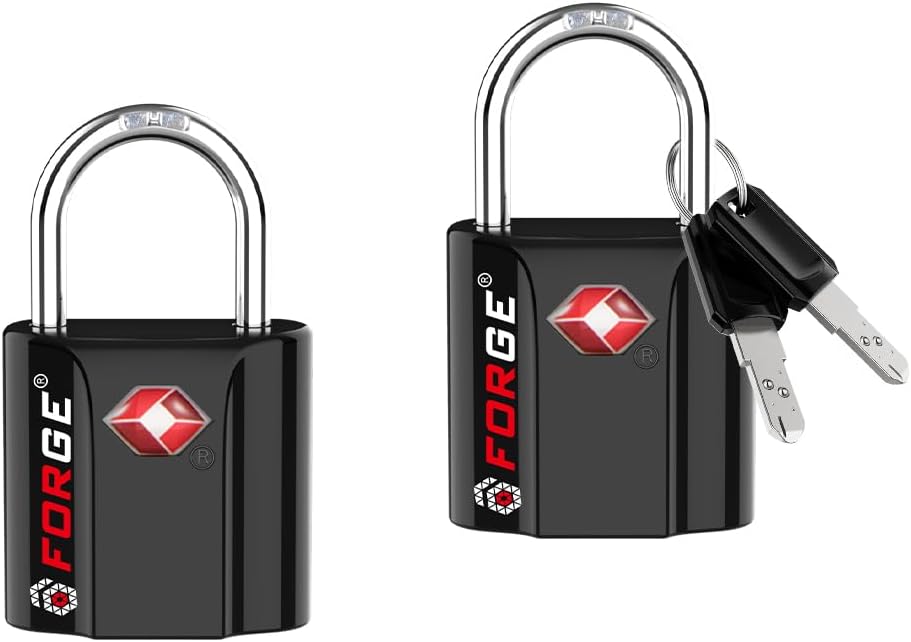
FORGE Small TSA Accepted Keyed Luggage Locks, Dimple Key, Black 2 Pack.
Check current Amazon price.
The case for this one is the two-pack and the dimple key. Two locks means a carry-on and a checked bag are covered from the same purchase, and a spare lives in the front pocket of the bag rather than in a kitchen drawer. The keyed design removes the failure mode I see most often on combination locks, which is a traveler standing at a check-in counter trying combinations they half remember.
The trade-off is the obvious one: a keyed lock is only as good as your key management. One key goes on your everyday keyring, the spare goes in a bag pocket that is not the pocket the lock is on, and if you are the person who has replaced a car key fob twice this year, buy the combination lock below instead. Small keyed locks like this are built for zipper pulls and small hasps, not for a hard case latch.
Flaws but not dealbreakers: keyed locks concentrate all the risk in one small piece of metal. Lose the key and the lock is a paperweight until you cut it off, so the spare is not optional.
Anyone with two bags and a reliable keyring will get along with this pair fine.
The tight-gap pick: SURE LOCK Mini TSA Approved Keyed Luggage Lock, One Key Opens All, Fits Tight Zipper Gaps & Small Pull Holes, Compact Travel Lock for Suitcases, Backpacks & Handbags
The tight-gap pick
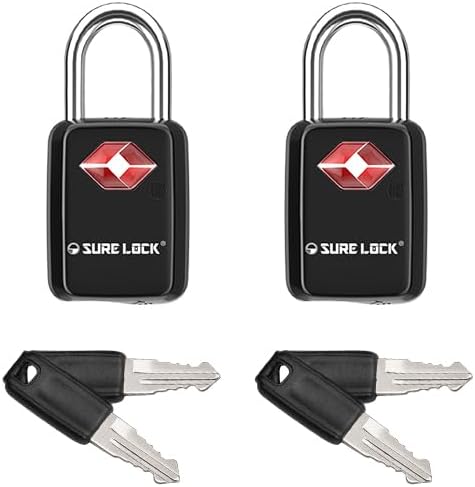
SURE LOCK Mini TSA Approved Keyed Luggage Lock, One Key Opens All, Fits Tight Zipper Gaps & Small Pull Holes, Compact Travel Lock for Suitcases, Backpacks & Handbags
Check current Amazon price.
This is the lock for the bag whose pull holes are so tight that a normal shackle will not pass through, and for anyone who wants one key for every bag they own. One key opens all is not a gimmick when you travel with a carry-on, a personal item, and a checked duffel: it means one key on the ring instead of three, and no fishing through a pouch at the gate.
Two notes, both in character. First, the listing name uses the word "approved," and that word means nothing on its own. What you want to confirm is the Travel Sentry mark on the lock body, visible in the product photos, because that is the mark that tells a screening officer the lock can be opened with a master key rather than cut. Second, a mini lock is small by design, so it will thread through a single pull hole easily and two stacked pulls with less room to spare. Check the gap before you commit.
Flaws but not dealbreakers: the compact body is the whole point and also the limit. This is not the lock for a hard-shell case with a latch, and the small key is easier to misplace than a full-size one.
Anyone with a soft bag, tight pulls, or a growing collection of locks that should all answer to one key should start here.
The combination pick: Samsonite 3-Dial Combination Lock, TSA Approved Travel Lock, Black
The combination pick
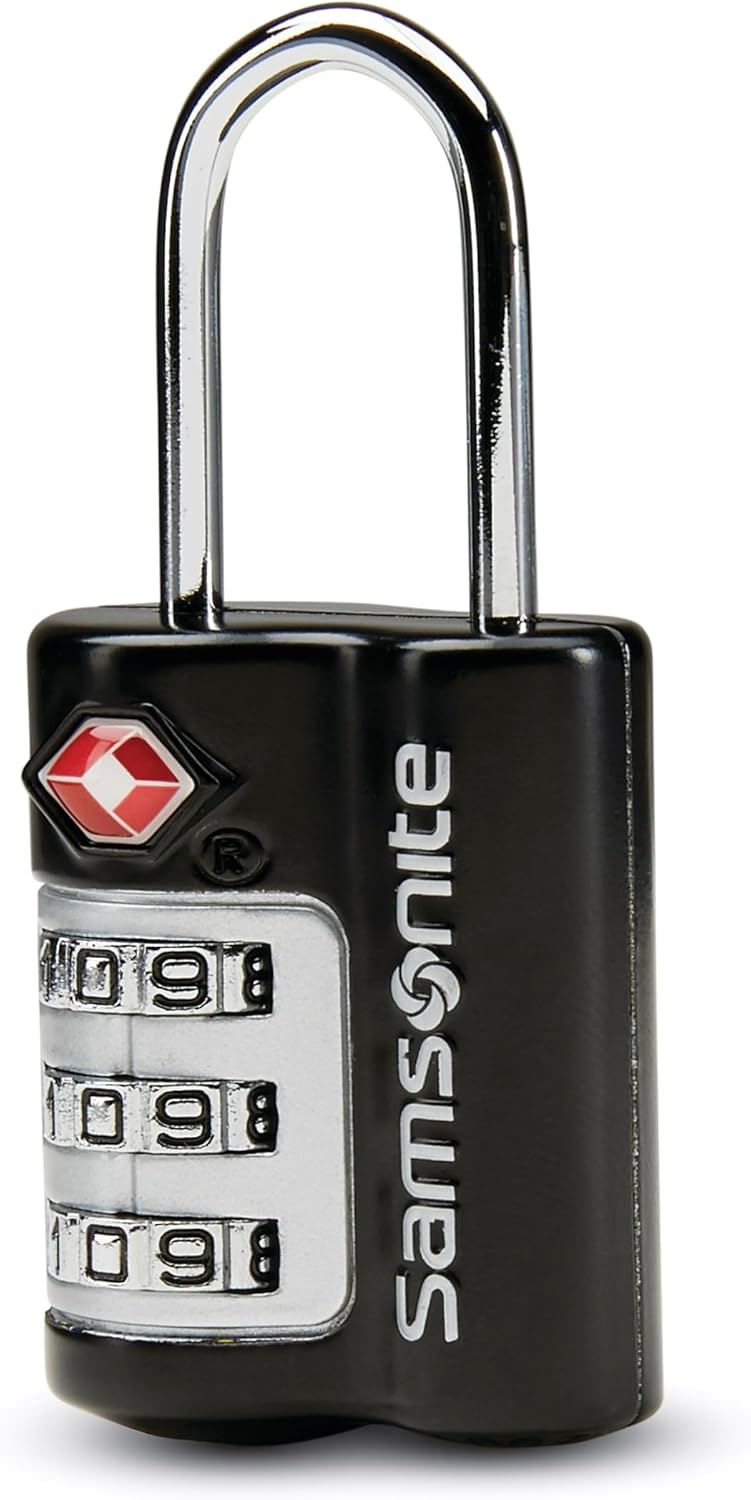
Samsonite 3-Dial Combination Lock, TSA Approved Travel Lock, Black
Check current Amazon price.
A three-dial combination lock solves the lost-key problem completely, which is why it is the lock I would hand to most people. There is nothing to carry, nothing to leave in a hotel room, and nothing to explain to a colleague who borrows your bag. The black body is unremarkable, which is exactly what you want on a bag that goes through a hold.
The cost is memory. A three-dial lock gives you a thousand possible combinations, which is enough to stop an opportunist rummaging in a hotel corridor and nowhere near enough to stop anyone determined with time and privacy. That is fine, because the lock is not the security system. It is the thing that makes your zipper inconvenient to open, and the TSA master key means screening does not end with a cut pull.
Set the combination at the kitchen table before the trip, not at the check-in counter, and write it somewhere that is not inside the bag the lock is on. If you reset it, do it at home with the instructions in front of you.
Flaws but not dealbreakers: a forgotten combination is worse than a lost key, because there is no spare. If you rotate combinations often, keep the number in your phone's notes.
Anyone who has ever arrived at a carousel with a lock and no key should buy this one.
How to choose luggage locks, step by step
This is the workflow I run before every trip, and it takes about ten minutes at the kitchen table.
Step one: Count the pulls and measure the hole. Look at the zipper on your bag and count how many pulls you intend to lock together. Then look at the hole in the pull, not the slider. If the hole is small, you are shopping mini locks, and no amount of reading about shackle strength changes that.
Step two: Decide keyed or combination, honestly. Keyed locks fail by lost key. Combination locks fail by forgotten combination. Pick the failure you are more likely to survive. If you travel with family and someone else needs to open the bag, a combination you can share verbally beats a key you have to hand over.
Step three: Confirm TSA acceptance, not the word "approved." Look for the Travel Sentry mark on the lock body in the listing photos. "TSA approved" in a product title is marketing text; the mark on the lock is the thing a screening officer looks for. A lock without it may be cut during a bag inspection, and that is a broken zipper, not just a broken lock.
Step four: Match the lock body to the zipper gap. A large lock on a soft bag swings, catches on conveyor edges, and stresses the pull. A tiny lock on a stiff pull is fiddly to thread in a hurry. The right size is the smallest lock that still passes through both pulls with a little slack.
Step five: Buy one per bag plus a spare. Locks are cheap and airport replacements are not. A spare in the bag's own pocket has saved me twice, once when a lock body cracked and once when a key vanished between the hotel and the terminal.
Step six: Set and record the combination at home. If you bought a combination lock, set it before you pack, test it open and closed three times, and store the number somewhere outside the bag. If you bought keyed locks, put the spare key in a different bag than the lock it opens.
Step seven: Lock both pulls, not one. A single locked pull can be slid along the zipper track on many bags, which defeats the point. Thread the lock through both pulls, push them together, and check that the teeth are fully meshed before you close the lock.
Step eight: Treat it as a deterrent and pack accordingly. A luggage lock keeps an opportunist out of your zipper and signals that the bag is not the easy one. It does not protect valuables, and nothing you check should be something you would grieve. Passports, medication, and electronics ride with you; see my notes on travel document organizers for keeping that kit in one place.
The competition and why it lost
Cable locks lost on thickness. A coated steel cable looks tough, but the thin ones that fit a standard pull hole fray at the crimp after a few trips, and the thick ones do not fit the bag you own. If you want a cable, buy one rated for the job and accept that it lives on the outside handle rather than through the pulls.
Brass padlocks lost on weight and fit. They are strong, they are also heavy, and the shackle diameter that makes them strong is the reason they will not pass through a zipper pull. A padlock belongs on a hard case latch or a locker, not on a softside.
Zip ties and disposable security seals lost on the return trip. They work one way, they cannot be reopened by you or by a screening officer, and cutting one off at the carousel with a house key is a bad five minutes. The whole reason to pay for a TSA-accepted lock is that the bag can be opened and reclosed without damage.
Luggage straps with a built-in lock lost on redundancy. The strap is genuinely useful for a bag that might pop, but the little lock on the strap is usually the weakest part of the assembly, and if it fails you have lost the strap's function as well. Buy the strap and the lock separately and each one does its own job.
What is left is the shape of the three locks above: small, TSA-accepted, and cheap enough that replacing one is not a decision.
What this all costs
All three locks sit in the same low-price band, which is the honest reason this decision is worth ten minutes rather than ten hours. Check current Amazon price on each before you buy, because the spread between them is small enough that fit should decide it, not a dollar or two.
The real math is what a failure costs. A cut zipper pull means a repair or a new bag. A lock that does not fit means a return, or a bag that travels unlocked. A lost key means cutting a lock off at a hotel desk with whatever the front desk has in a drawer. Against that, buying one extra lock as a spare is the cheapest insurance in the whole packing list.
My recommendation, plainly: buy the combination lock if you are buying one, buy the two-pack of keyed locks if you want a spare without thinking about it, and buy the mini keyed lock if your pulls are tight or you want one key for every bag. Then run the eight steps once, at home, before the trip where it matters.
That is the job. The lock is not there to make the bag invincible. It is there so the zipper is not the easiest thing on the carousel to open, and so you are not the traveler at the counter with a broken pull and a story.