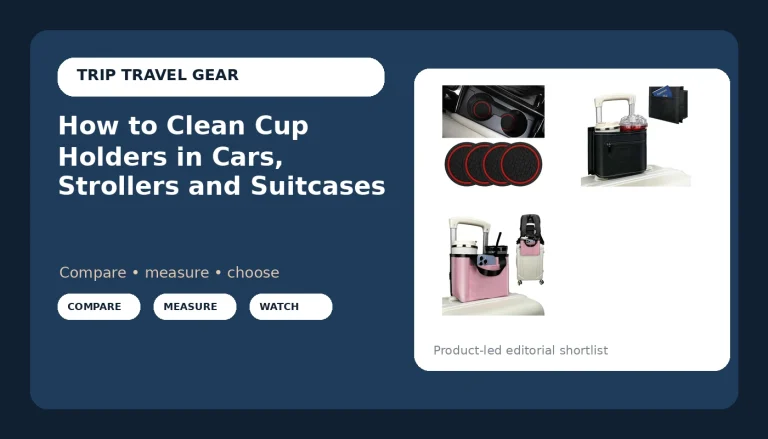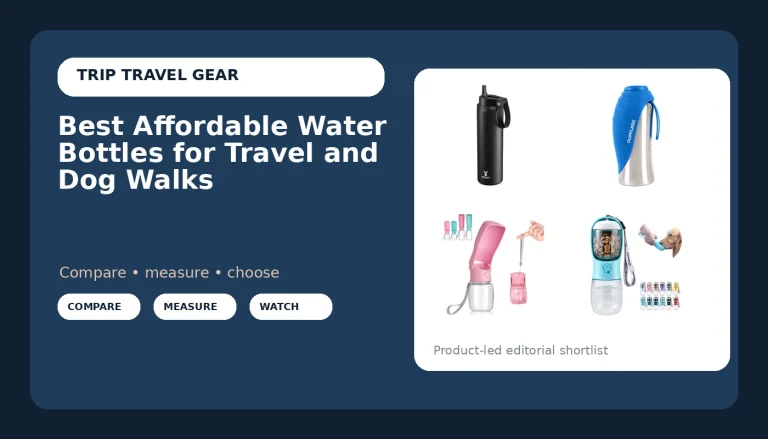
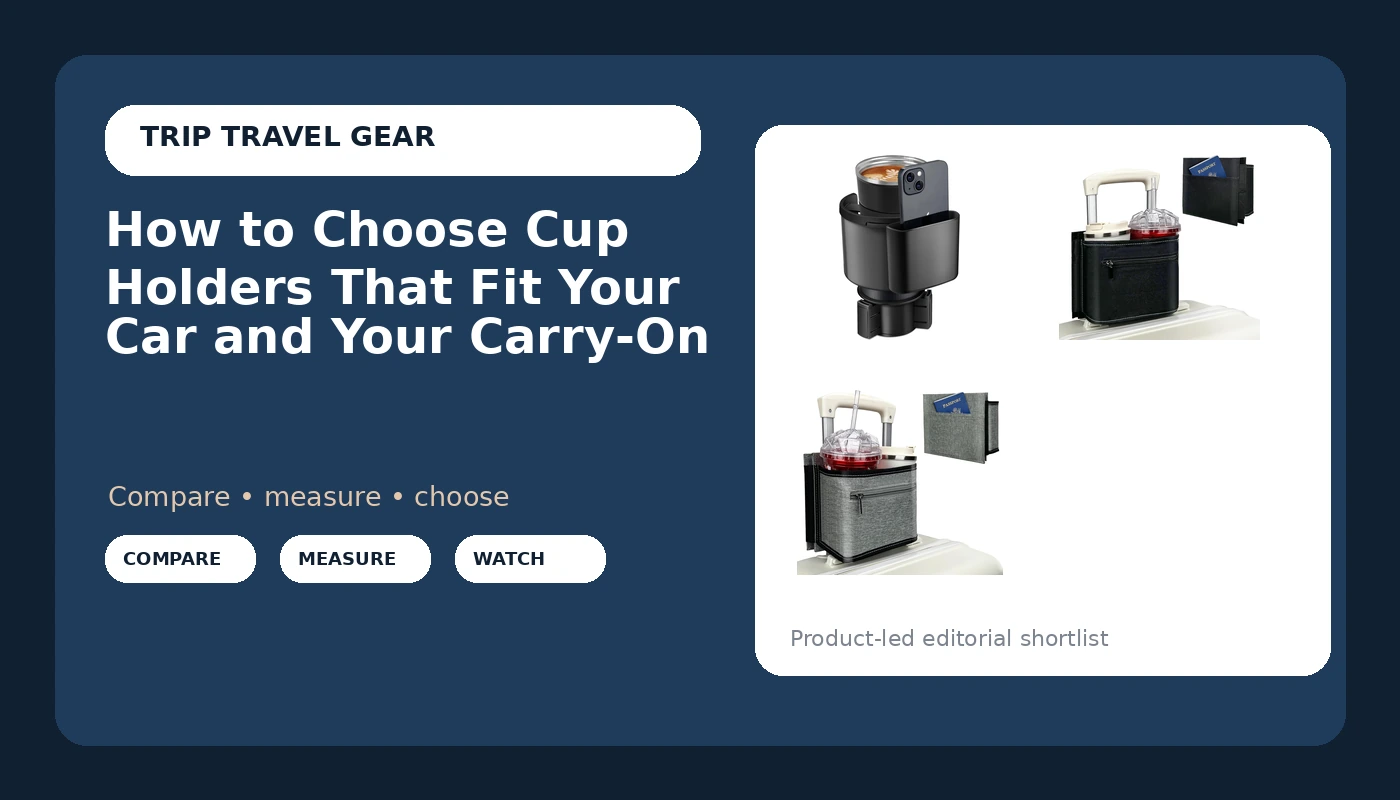
Learning how to choose cup holders takes about ten minutes of measuring and one honest look at how you travel. Everything after that is marketing. A cup holder is a clamp, a well insert or a sleeve, and the only questions that matter are what it grips, what it holds, and what it does to the thing it is attached to.
I spent eleven years as a regional sales rep flying more than ninety segments a year, and I have bought these badly. One insert rattled loose in a rental sedan and tipped a full iced tea into the passenger footwell. One suitcase holder had a clamp that closed on nothing and lived in a drawer for a year. The one in my car now is the third attempt, and it works because I finally measured the well before I ordered instead of after.
Below is the method I use, the two design families worth owning, and three specific products: a car well insert that expands, and a suitcase attachment sold in two colorways. Treat the middle of this piece as the Cup Holders buying guide I wish I had before the iced tea. None of it is expensive, which is exactly why the wrong one is so easy to buy twice. Check current Amazon price on each listing before you commit, because these listings move.
Why you should trust me
I am not a gear reviewer with a warehouse. I am the person a small adventure-travel operator used to hand a clipboard to before a trip: two years of gear checks, bag by bag, before the van left. Before that came eleven years of sales travel, which is where I learned that the in-flight problems are always small ones. A coffee with nowhere to go. A bottle rolling under the seat. A bag that will not stand up in a bin while you dig through it one-handed.
I keep a spreadsheet of carry-on dimensions by airline and a drawer of TSA locks that failed. I have never run a lab test on a cup holder, and I say so where it matters. What I can tell you is what the spec lines state, what the reviews repeat, and what the geometry of a car well or a telescoping handle does to a full cup. When a claim needs a test I have not run, I label it as a claim.
How I picked and how I tested
I judged every holder on four things, in this order.
Grip. For a car, the question is the well: inside diameter, depth, and whether the console lid or the shifter crowds the space above it. For a suitcase, the question is the handle gap, meaning the space between the two bars of a telescoping handle and how far a clamp has to close on it. A holder that grips nothing is a bag of parts.
Load. A full 32-ounce bottle is heavy, and anything tall turns into a lever. On a suitcase, that lever pulls on the same handle you are steering with. In a car, it pulls on the insert, which is why an adjustable base matters more than a nice finish.
Range. The car insert I recommend states 16 to 46 ounces, which covers a disposable water bottle through a large insulated bottle. Anything narrower and you are buying for one bottle, not for your week.
Failure. I read the low-star reviews looking for the same sentence twice: the clamp that will not stay, the base that walks out of the well, the hinge that snaps. One repeated complaint is a pattern. Three is a design.
I measured the wells in my own car and the handle on the rollaboard I actually travel with, the one on my carry-on shortlist, then compared those numbers against what each listing states. That is a bench check at home, not an airport trial, and I have labeled it that way throughout.
Here is what survived.
Our pick for the car: Car Cup Holder Expander with Adjustable Base, Fits Bottles 16-46 OZ
Our pick for the car
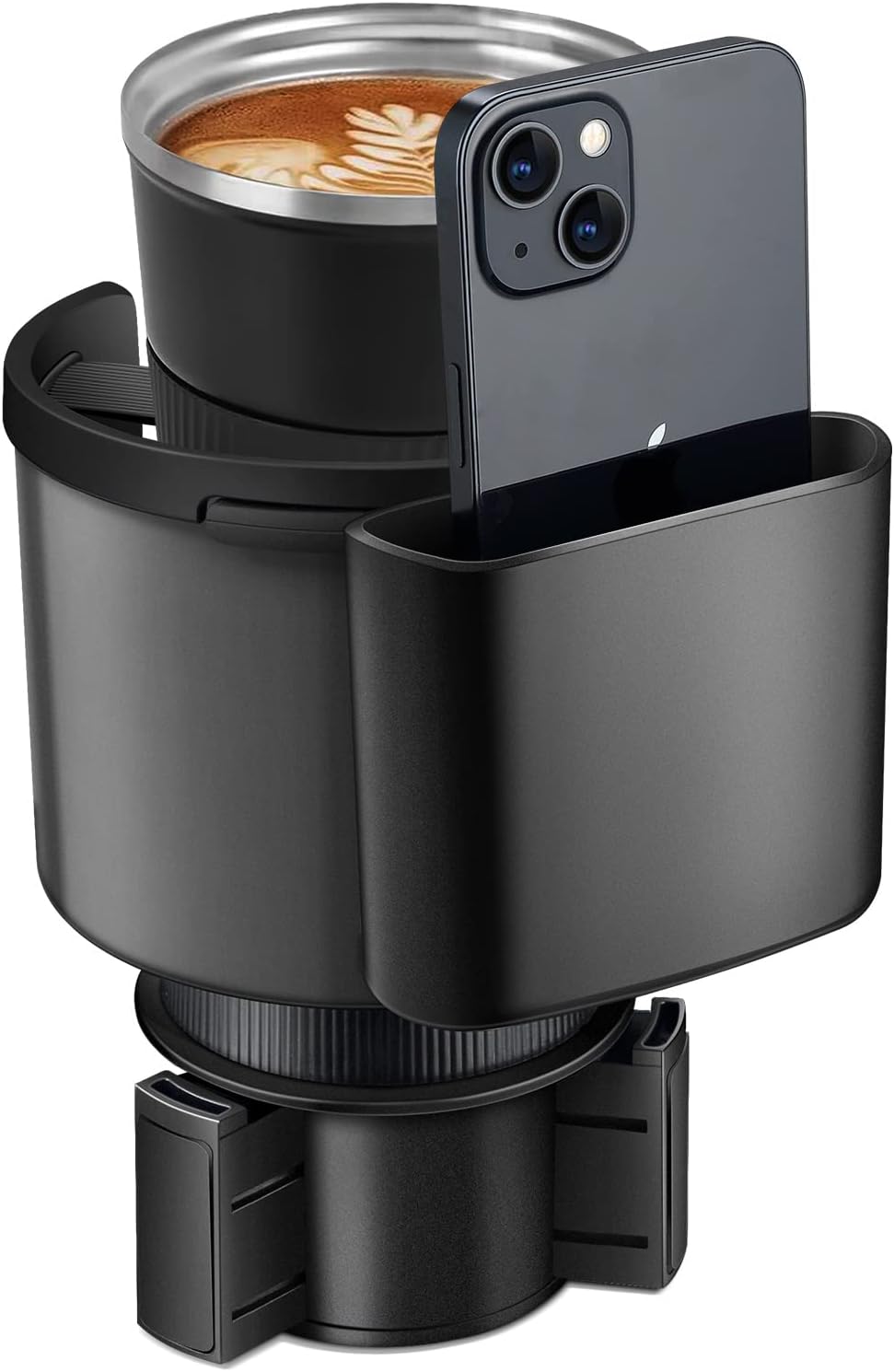
Car Cup Holder Expander with Adjustable Base, Fits Bottles 16-46 OZ
This is where I would start if your problem is a bottle in a car. The adjustable base is the feature that earns the space: a fixed insert is molded for one well diameter and one well depth, so it fits the car it was bought for and rattles in the next rental. An expanding base closes the gap instead, and the stated 16 to 46 ounce range covers everything from a disposable water bottle to a large insulated bottle.
What it will not do is make a shallow well deep. A tall bottle still stands above the console, so check two clearances before you order: the console lid above it and the shifter beside it. It also occupies the well it sits in, which matters in a car with one well and two people drinking coffee.
Flaws but not dealbreakers: It is a single-purpose object that takes up a well you already had. If your car has deep wells and you drink from a standard cup, you may not need it at all.
Our pick for the suitcase: Travel Luggage Cup Holder, Vethers Drink Carrier, Luggage Cup Holder Attachment, Free Hand Suitcase Drink Carrier for Drinks Beverages, Coffee, Bottles, Snacks (Jet)
Our pick for the suitcase
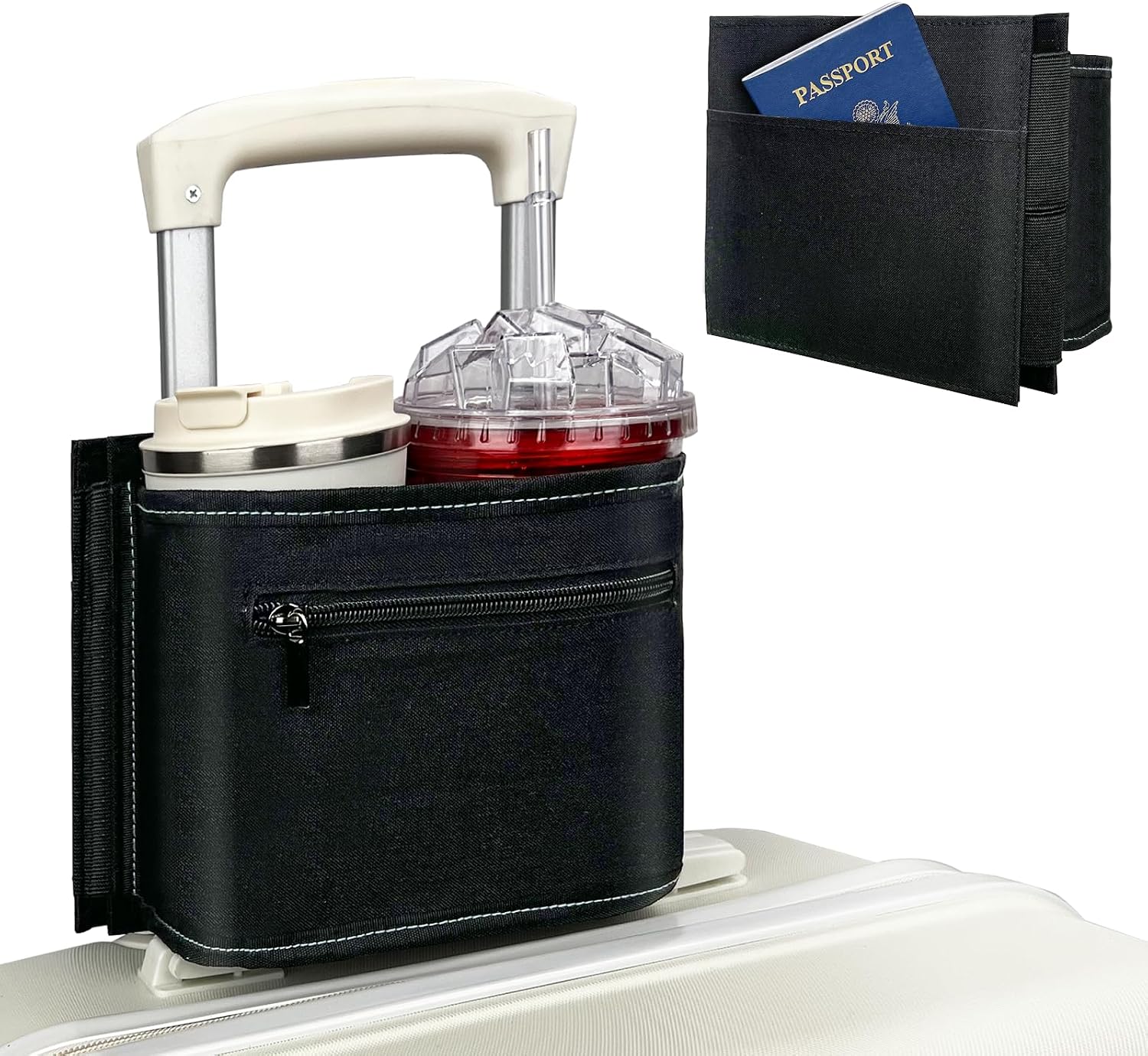
Travel Luggage Cup Holder, Vethers Drink Carrier, Luggage Cup Holder Attachment, Free Hand Suitcase Drink Carrier for Drinks Beverages, Coffee, Bottles, Snacks (Jet)
This one solves the terminal problem: a coffee in one hand, a phone and a boarding pass in the other, and a rollaboard handle going the wrong way. It attaches to the suitcase handle and holds drinks, coffee, bottles and snacks, which frees the hand that was doing the balancing. The Jet colorway is the darker of the two.
The trade-off is where the weight sits. Everything in the holder hangs on the telescoping handle, the same handle you are pulling at an angle through a concourse. A full bottle on a single-stage handle will make the bag feel heavier than it is, and it will wobble if the clamp is not snug against both bars. Before you order, measure the gap on your own handle, the space the clamp has to close on. A clamp that is too wide slides, and one that is too narrow will not seat.
Flaws but not dealbreakers: It is an attachment, not a conversion. It does nothing in a car, and nothing on a soft bag with no rigid handle to grip.
The other colorway: Travel Luggage Cup Holder, Vethers Drink Carrier, Luggage Cup Holder Attachment, Free Hand Suitcase Drink Carrier for Drinks Beverages, Coffee, Bottles, Snacks (Snowy Gray)
The other colorway
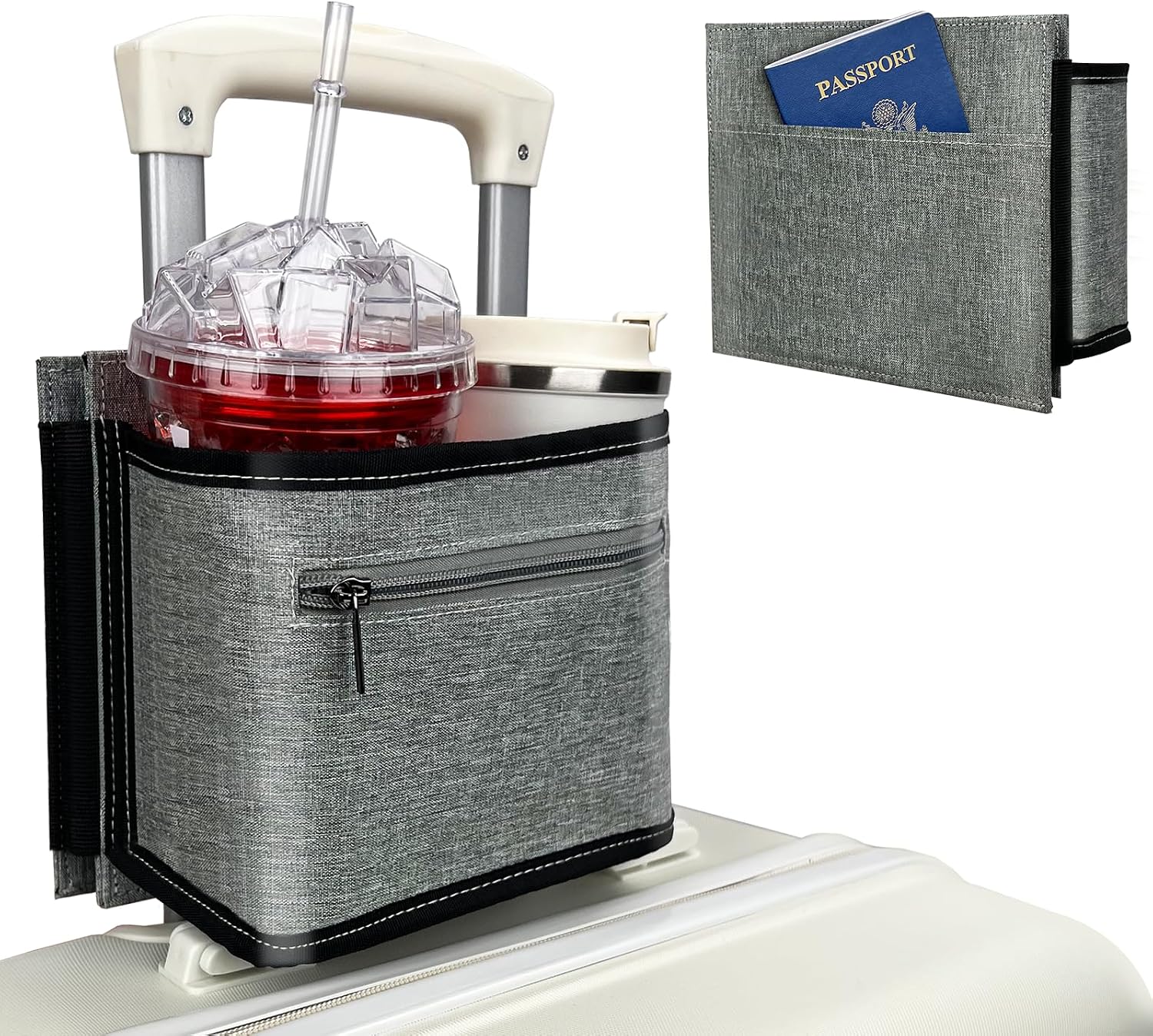
Travel Luggage Cup Holder, Vethers Drink Carrier, Luggage Cup Holder Attachment, Free Hand Suitcase Drink Carrier for Drinks Beverages, Coffee, Bottles, Snacks (Snowy Gray)
Same holder, same attachment, different color. Choosing between the two is a visibility decision, not a performance one. A light gray holder on a dark bag is easier to find when you are pulling the bag out of an overhead bin at an awkward angle, and a dark one hides the scuffs that come from being knocked against seat frames and jet bridge rails.
If you travel with a black rollaboard, the gray is the easier one to spot. If your bag is already light, or you would rather the holder disappear, take the Jet. Availability on the two colorways is not always the same, so look at both listings before you decide.
How to choose cup holders: the eight-step workflow
Now the part you came for. This works for a car well, a suitcase handle or both, and it takes less time than a gate delay.
Step one: Measure the well. In the car, measure the inside diameter of the cup well and note the depth. Then measure the diameter of the widest bottle you actually carry, not the one you wish you carried. Those two numbers decide whether you need an expanding insert or nothing at all.
Step two: Measure the handle. On the suitcase, measure the gap between the two bars of the telescoping handle and estimate how far the clamp has to close. Do it with the handle extended, which is the position it will be in when the holder is carrying weight.
Step three: Decide which problem you have. A car problem and a suitcase problem are different purchases. If your bottle rolls around the console, you want an insert. If your coffee has nowhere to go while you walk, you want a handle attachment. Buying one to solve the other is how drawers fill up.
Step four: Match the range to your bottle. This is the Cup Holders size guide part of the job, and it is short. The car insert states 16 to 46 ounces. If you carry a 64 ounce jug, that is a different product and a different search. If you carry a tapered travel mug, check how it sits in a well sized for a straight bottle.
Step five: Check what it occupies. Everything a holder grips, it also blocks. A car insert takes a well. A handle attachment takes handle space and adds width to the top of the bag. Count what you are giving up before you count what you are getting.
Step six: Read the reviews for the failure, not the feature. Skip the five-star paragraphs that describe the box. Read the two- and three-star ones and look for the same sentence twice. The clamp that will not stay tight, the base that walks out of the well, the hinge that cracks. Cup Holders reviews are most useful when you read them for what broke.
Step seven: Check the fit against your own gear. A holder that fits a generic rollaboard may not fit yours. The short version of how to choose cup holders is measure, match, then read the failure, and this is the step people skip. It is also the reason a holder ends up in a drawer.
Step eight: Buy one, run it for a trip, then decide. Give it one round trip before you buy a second. Most travelers need one holder, not three. If the first one solves the problem you measured in step one, you are done.
The competition and why it lost
Three other designs came up while I was comparing, and each lost on a stated trade-off rather than on being bad.
The tray-table clip. It clamps to a folded tray table and holds a cup at seat height. It loses on the descent: everything has to come off the table and go back in a bag before landing, so a holder that must be stowed is not solving the free-hand problem, it is relocating it. Fine on a long cruise, wrong on a short hop.
The stroller-style clamp. These are the pincer clamps sold for strollers and bike frames, and some travelers adapt them to a suitcase handle. They lose on the handle gap: a pincer sized for a round tube does not close flat on two square bars, so it rotates. Good idea, wrong geometry.
The console organizer. A fabric or molded tray that sits on the passenger seat or the console and adds cup wells. It loses on the well it was supposed to fix, because the organizer's wells are shallow and a tall bottle tips the whole tray. It also turns a seat into a shelf nobody can use.
The hard plastic well insert. This is the closest competitor to the expander, and it loses on adjustability: one diameter, one depth, no expansion. In the car it was molded for, it works. In a rental, it rattles.
What none of these do is the thing that matters: hold the bottle you actually carry, in the place you actually put it, without moving. When you sort by rating, look at what the top rated Cup Holders have in common. A clamp that closes, a base that stays put, and no extra hinges.
What this all costs
No current prices here, because these listings move more than the gear does. Check current Amazon price on each of the three before you decide, and treat the number as the least interesting part of the purchase.
The way to think about cost is in trips, not dollars. The car insert and the suitcase holder solve different problems, so the honest question is which problem you have on your next trip. If you drive to the airport and then walk a concourse with a coffee, you may want both, and you may find the suitcase holder is the one you use more often, because it works in the terminal, on the jet bridge, and in the rental car lot while you dig for keys.
What you should not do is buy a holder to compensate for a bag that will not stand up or a bottle that will not seal. A holder is a small piece of plastic that keeps a drink upright. It cannot fix a leaking lid, and it cannot make a soft bag roll straight.
The other cost is space. A car insert lives in a well you might want for a phone or a pair of sunglasses. A handle attachment adds a few inches to the top of a bag that may already be close to a carrier's sizer. Both are small, and both are the kind of thing you notice at the worst moment.
If you are shopping the best budget Cup Holders rather than the fanciest ones, you are in the right category, because there is not much to spend money on here. Two parts, one job. Buy one, run it for a trip, and let the second purchase wait until you know which problem is actually yours. That is how to choose cup holders in one sentence: measure what you are clamping to, match what you are carrying, and read the reviews for the part that breaks.