

I have flown enough segments out of PDX to know that the doyike vs wrangler travel duffels question is almost never about the two names inside it. It is about whether a big, cheap, soft bag is a travel bag or a storage sack with a strap sewn onto it, and that question gets answered by four numbers: exterior dimensions, stated volume, fabric weight, and what the strap is actually sewn into.
I spent eleven years as a regional sales rep and two more running gear checks for an adventure travel operator, and the only habit that survived all of it was a spreadsheet of carry-on dimensions by airline. The sizer at the gate does not care what the listing said. So this is not a page where I tell you a bag "felt roomy." I have not flown with the four bags below, and I am not going to pretend otherwise. What I can do is read each listing the way a gate agent reads a measuring frame, and tell you which one fits which trip.
If you came here looking for DoYiKe vs Wrangler travel duffels, the honest answer is that neither of those two bags has a verified record in front of me, so I will not invent dimensions for them. Of the four bags I can actually read, the split is clean: the Osprey Daylite convertible is the one that behaves like travel luggage, the brown leather weekender is the one that behaves like business luggage, and the two large canvas bags are moving and storage tools that happen to have shoulder straps.
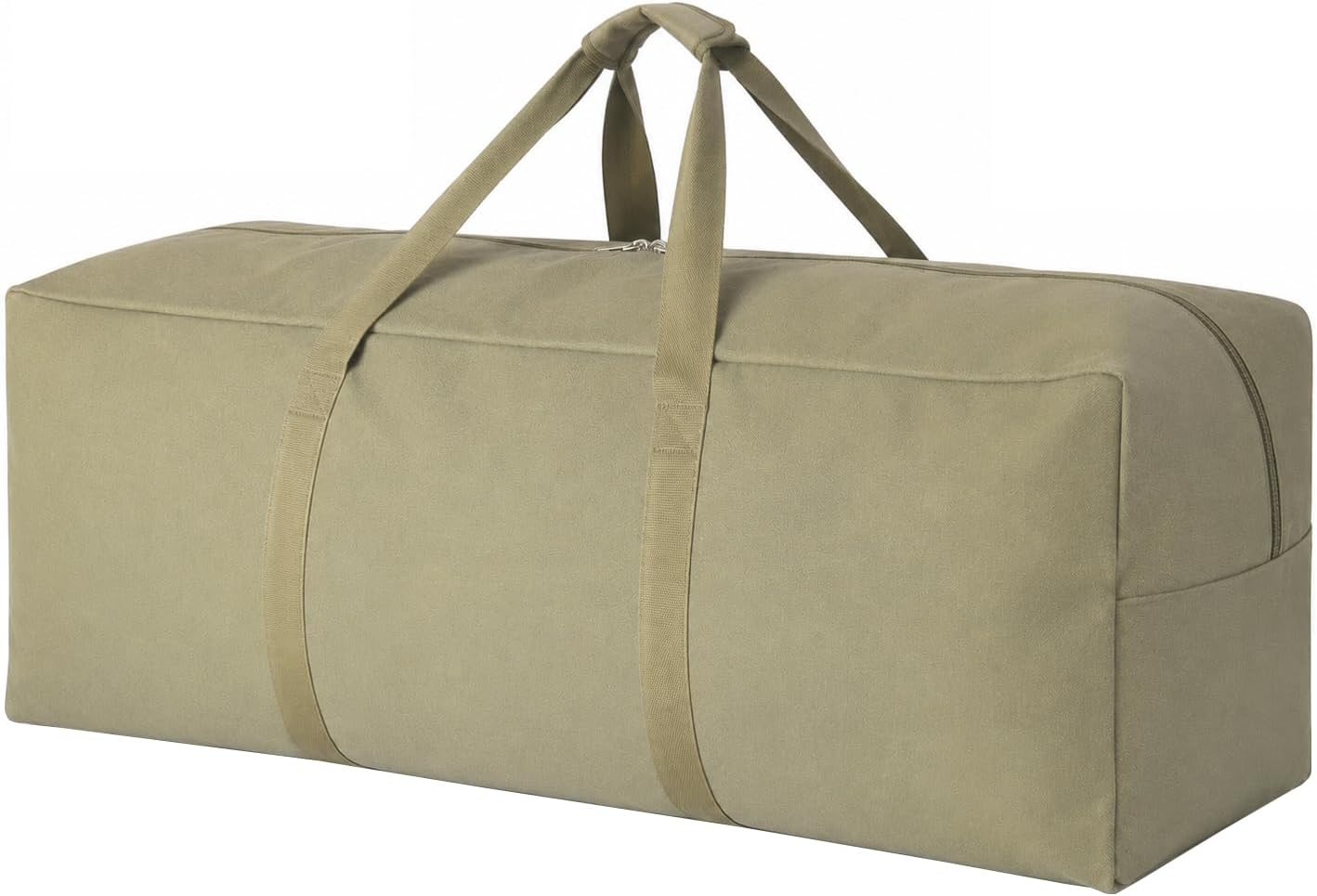
Extra Large Canvas Travel Duffle Bag Heavy Duty, 100L Armygreen
100 liters of stated volume, framed for sports, military and tent storage, so the maker is honest about where it lives
No exterior dimensions, fabric weight or hardware stated, and no wheels, so a full bag is a two-person lift
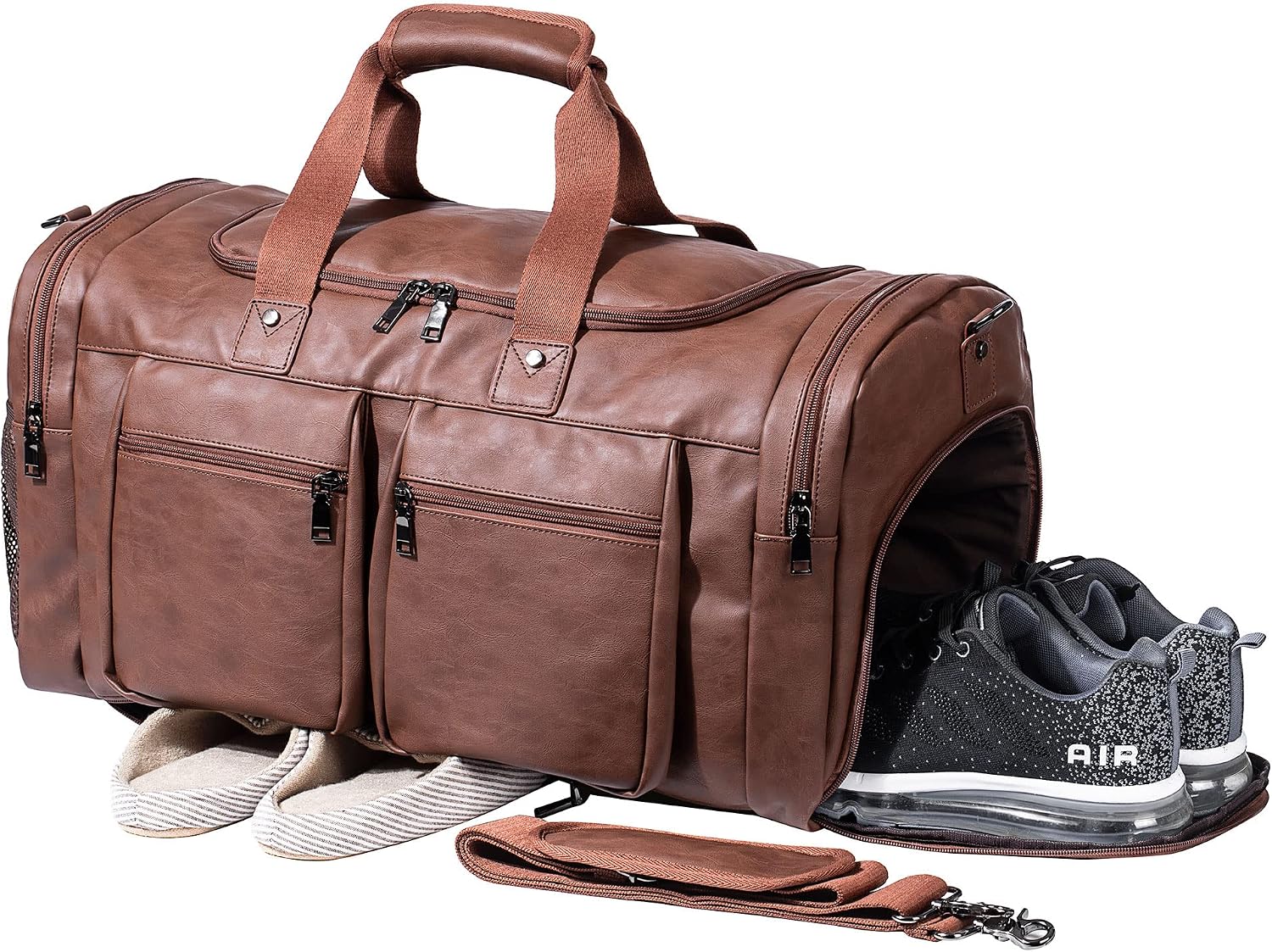
Leather Travel Bag with Shoe Pouch, Weekender Overnight Duffel, Brown
Holds its shape, includes a separate shoe compartment, reads as business luggage instead of a gym bag
Leather is the heaviest material here, and the carry-on claim in the title has no dimensions behind it
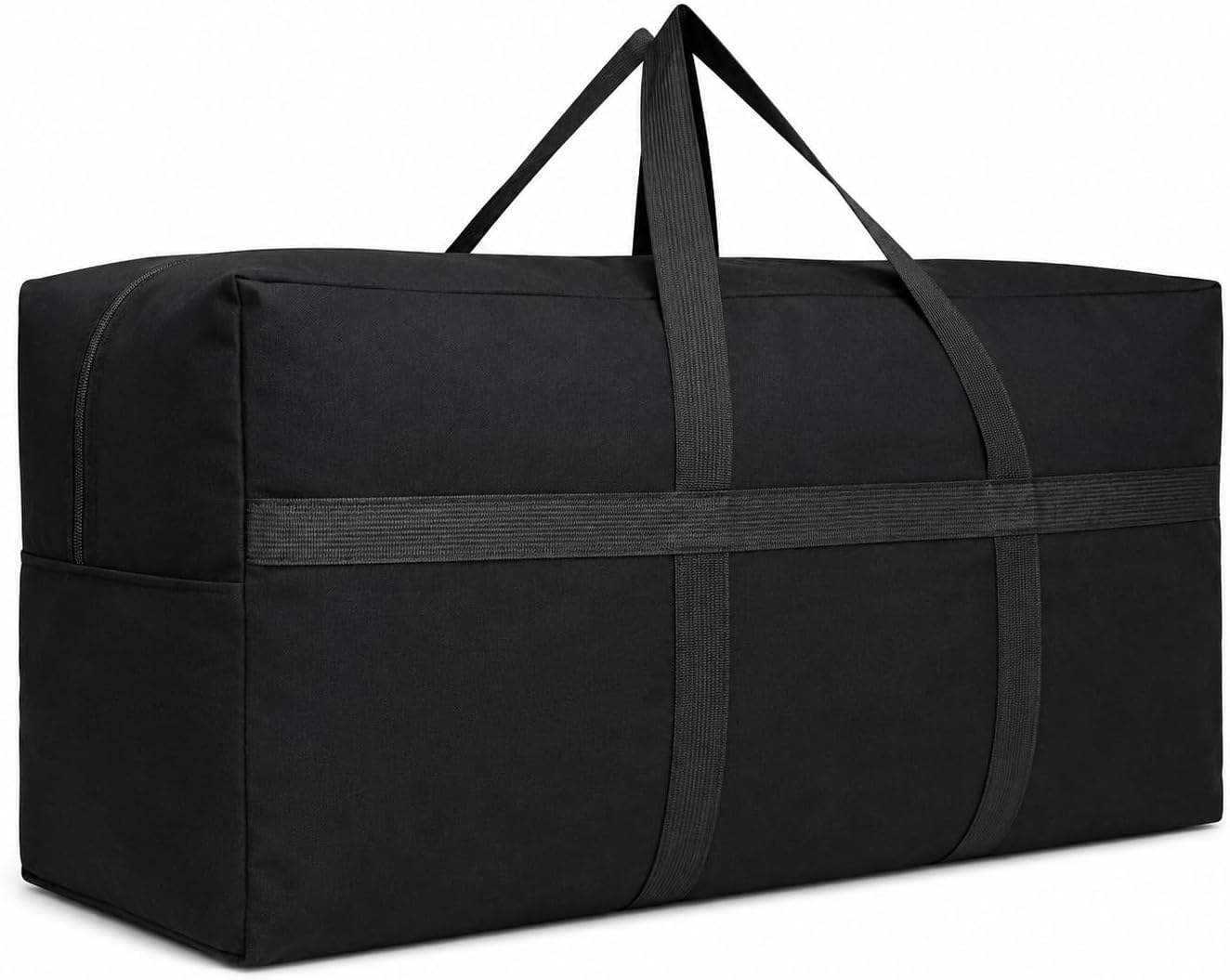
Extra Large Canvas Storage Duffle Bag, Black 130L
Largest stated volume of the four, and it folds flat when empty
130 liters is storage volume, not travel volume, and the listing states no harness, wheels or base panel
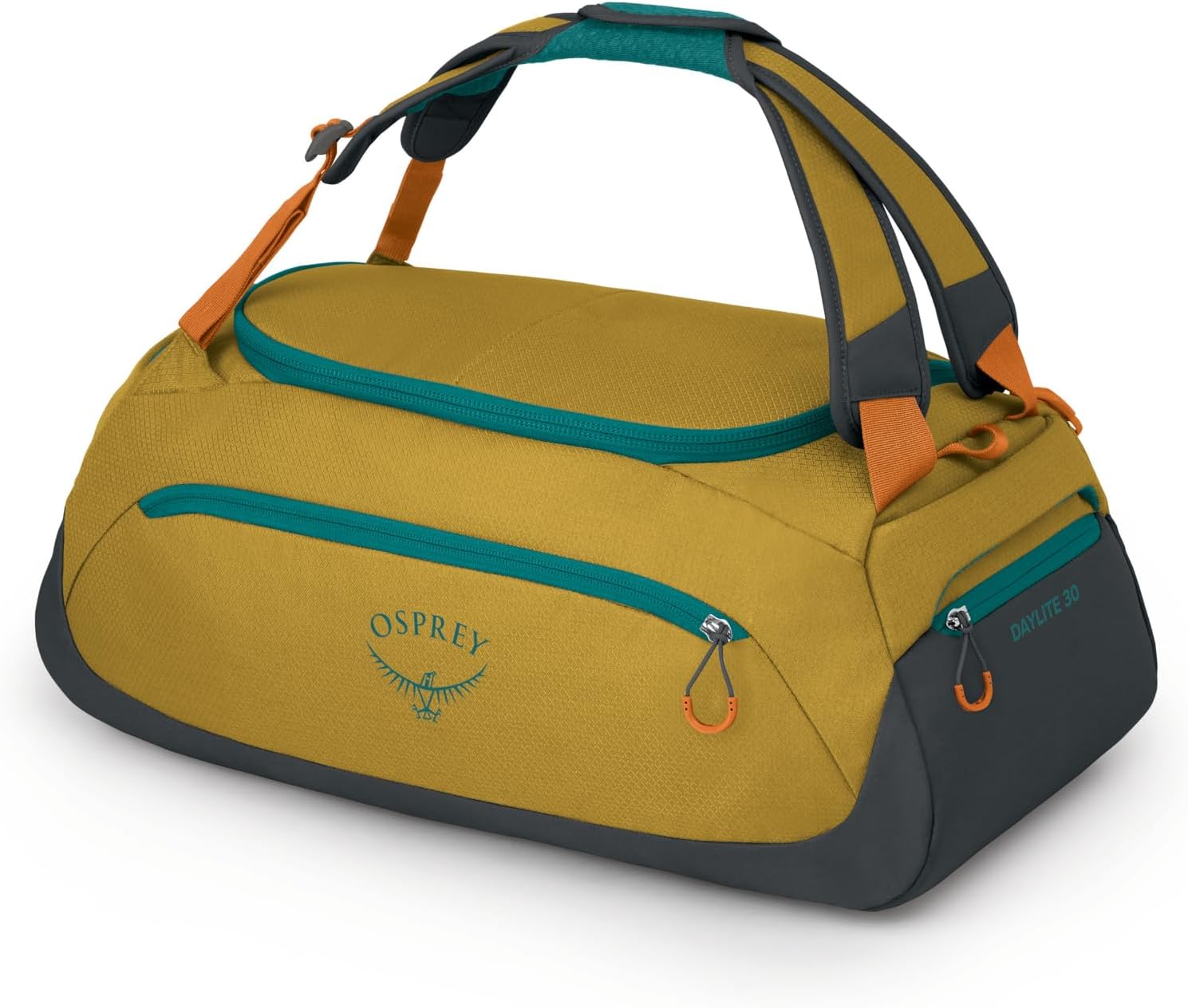
Osprey Daylite Duffel Backpack, Convertible Duffel
The only one of the four with a stated carry system, a duffel that converts to a backpack
Smallest of the group by volume, so it is a weekend and gym bag, and the harness eats interior space
Prices and availability may change.
How I judge a duffel listing
Five things, in this order. Exterior dimensions in inches, because that is what a sizer measures. Stated volume in liters, because that is what the marketing leads with and it is the least comparable number on the page. Fabric weight in ounces per square yard for canvas, or denier for nylon, because a 100 liter bag made of thin duck will fail at the strap long before it fails at the seam. Zipper and hardware, meaning whether the listing names the zipper at all. And the strap attachment, which on a soft bag is where the load actually lives.
If a listing is missing any of those, I treat the bag as unmeasured rather than bad. That is the difference between a real Travel Duffels buying guide and a slideshow of product photos. The four bags here sit at very different levels of disclosure, and that gap is honestly the most useful thing on this page. Two of them tell you a volume and a material. One tells you a carry system. One tells you almost nothing beyond a title and a color.
I also read the return window before I read the price. A bag you can send back is a bag you can measure at home with a tape, load with clothes, and walk around the block. That test costs nothing and beats any spec sheet.
What doyike vs wrangler travel duffels searches actually need
The search string is a proxy. What the person typing it wants to know is whether the unbranded large canvas bag and the branded one are the same object with a different tag on it. The answer is that fabric and stitching decide that, not the badge, so a doyike vs wrangler travel duffels comparison that stops at the label is useless to you.
Since neither name has a verified record in this batch, I am not going to hand you made-up dimensions for either one. What I can do is name the three places where a big canvas duffel separates into a good one and a bad one, so you can check both of those listings yourself.
First, stated fabric weight. Duck canvas is usually sold somewhere between roughly 12 and 18 ounces per square yard, and the heavier end is what makes a bag hold a shape when it is half full. A listing that says "heavy duty" and never says ounces has told you nothing you can compare.
Second, the strap attachment. Look for a box-X stitch, or a strap that wraps under the bag and is stitched into a reinforced panel. A single row of stitching at the top of the side panel is the first thing to go, and it goes with a full bag on a stairwell, which is the worst possible place for it.
Third, a flat base panel with a reinforced bottom or feet. A storage duffel built as a plain tube will roll over every time you set it down. That matters far more at 100 liters than at 40, because the bag is taller and the center of gravity is higher.
Canvas haulers: 100 liters and 130 liters
Two of the four bags are large canvas volumes with no wheels, no stated harness and no exterior dimensions in the record.
The armygreen bag states 100 liters and frames itself as sports, military, camping and tent storage. That framing is honest, and it tells you who the bag is for: gear that rides in a truck bed, a garage shelf or a base camp tent. The black bag states 130 liters and calls itself a storage duffel. At that size it is a moving box with a strap.
Here is the arithmetic that makes those numbers mean something. A common published carry-on envelope is about 22 by 14 by 9 inches, which works out to 2,772 cubic inches, or roughly 45 liters. So a 100 liter bag is a bit over twice a carry-on, and a 130 liter bag is close to three of them stacked together. Neither is a cabin bag on any carrier I know of, and you should verify the limit with yours anyway, because limits change and the published number is the only one that counts.
The practical consequence is weight. Canvas at that volume, packed with clothes, is not a bag you carry on one shoulder for six blocks. There are no stated wheels on either one, so the honest use case is a vehicle trip, a move, or gear that gets loaded once and unloaded once. My Travel Duffels size guide shorthand is simple: 40 to 45 liters is a carry-on duffel, 60 to 70 liters is a checked week, and above 90 liters you are moving things rather than traveling with them.
Where these two win is storage and abuse tolerance. A canvas sack with no frame folds flat in a closet and does not care about mud, sand or a wet tent floor. Where they lose is anything involving a walk.
The leather weekender and the carry-on claim in its title
The brown leather bag is the only structured bag in the group. The title says waterproof leather, large, carry on, and it includes a shoe pouch.
Two of those claims are checkable and one is not. The shoe pouch is a real feature with a real job: a separate compartment keeps a pair of shoes off clean clothes, which is the single most useful thing a weekender can add. Waterproof leather is a material claim you can test yourself with a damp cloth on an inconspicuous panel before you trust it in the rain.
The carry-on claim is the one I would not take from a title. There are no exterior dimensions in the record I have, and a leather duffel holds its shape, which means it does not squeeze into a sizer the way canvas does. Measure the empty bag, then remember that a full leather bag measures bigger than the spec sheet, not smaller. Verify the limit with your airline before you plan on the overhead bin.
The trade-off is weight and packability. Leather is heavier than canvas per square foot and it does not flatten when empty, so it costs you closet space and luggage rack space. What you get back is a bag that looks like it belongs in a client meeting rather than a hostel laundry room, which is a legitimate reason to buy one. Check current Amazon price if the structured look is the deciding factor for you.
The convertible: Osprey Daylite
The Osprey Daylite is the only bag of the four whose name describes a carry system instead of a capacity. It is a duffel that converts to a backpack, and that is the most useful trick in this entire category.
The reason is simple mechanics. A single shoulder strap puts the load on one set of muscles, and one hand is always occupied steadying the bag. A harness splits the load across both shoulders and frees your hands for a coffee, a boarding pass or a stair rail. On a train platform or a six block walk from a parking garage, that is the difference between arriving fine and arriving annoyed.
The cost is interior volume. A stowable harness and its back panel eat space that a plain tube uses for clothes. So the Daylite is a gym, commute and short trip bag, not a hauler, and it is the only one of the four I would call a travel bag first and a storage bag second.
I am not going to quote its capacity, weight or dimensions here, because those numbers are not in the record in front of me and I do not guess at them. Read them off the product page, then compare them to the linear inch limit published by your airline. Check current Amazon price when you have those two numbers in hand, because the size decision should come first.
Liters are not a size, and that is non-negotiable
The one rule I will not bend: the number that decides whether a bag flies is linear inches, not liters. Airlines publish a length, a width and a height, add them up, and measure the result against a frame at the gate. Liters never enter into it.
That means a 100 liter bag and a 45 liter bag can both be described honestly, and only one of them boards. It also means a soft bag has an advantage the spec sheet hides, which is that it compresses. But compressing means the bag bulges where the frame is tight, and a bulge above the frame line is a gate-check.
For anyone new to this, the Travel Duffels for beginners version is three lines long. Measure your packed bag with a tape, in inches, all three dimensions. Add them. Compare the total to your carrier's published limit, and re-check it the week you fly. That is the whole method, and it works on every bag you will ever own.
The best budget Travel Duffels are not simply the cheapest four listings either. A cheap canvas bag that loses a strap in month three costs more than a mid-priced one that does not, and the way you tell the difference before buying is whether the listing bothered to state the stitch pattern and the fabric weight. If it did not, you are buying a photo.
What the numbers say, and what a rating does not
Ranking pages and the top rated Travel Duffels carousels are sorted by a formula that weighs review count, recent sales and return rate. None of those is a specification. A bag can be top rated and still be the wrong linear size for your carrier, and it can be top rated while the strap attachment is the exact thing that keeps failing.
The Travel Duffels reviews that are worth your time are the boring ones. Sort by most recent, then search the page for the words strap, zipper, seam and handle. What you are looking for is repetition. Five mentions of the same strap pulling loose is a pattern. One mention of a color being slightly off is not.
The second number worth collecting is the weight of your packed bag. A kitchen scale handles it. Stand on the scale with the bag, subtract your own weight from the total, and you have the number the check-in counter will use. Do that in the last hour of packing, while you can still move a pair of shoes into a personal item.
Should you buy a scale and a tape before the duffel?
Yes, and before anything else in this category. A luggage scale is a small purchase that outlasts the bag, and a tape measure you probably already own. Together they turn every future duffel decision into a comparison instead of a guess.
The other pre-purchase test costs nothing. Load the bag at home the way you plan to travel, then walk a block with it. With a convertible, do that with the harness out and the shoulder strap stowed, because the conversion is the feature you are paying for and it is either comfortable with weight in the bag or it is not.
If a duffel fails that walk, it does not matter what the listing said. That is the same reason I keep a drawer full of locks that did not survive a single trip. The failure shows up in the living room, not at the gate.
What I am watching next
Two things. First, whether the large canvas listings start publishing exterior dimensions and fabric weight in ounces. The moment one of them does, it becomes comparable to the branded bags and the whole cheap versus expensive argument gets settled with numbers instead of adjectives.
Second, the convertible duffel category. The Daylite is the only bag here with a stated carry system, and that is the design decision that matters most for anyone moving through an airport or a train station with a full load. I want to see whether the interior volume penalty for a stowable harness gets smaller, because that is the trade-off keeping convertibles out of the large capacity end of the market.
Neither of those is a testing claim. When I have flown with a bag I will say so, with the segment count and the carrier named, because that is the only version of this worth reading.