
Most people who ask me how to choose foam sleeping mats are really asking two questions at once: how thick, and how small does it pack. Everything else, the cover fabric, the strap, the carry bag, the price, follows from those answers. Get them wrong and you own either a pad that feels like a yoga mat on gravel or a mattress that eats half your trunk.
I spent eleven years flying 90-plus segments a year as a regional sales rep, then two years running gear checks for a small adventure travel operator. The sleep question I get most from car campers and guest-room hosts is not about sleeping bags. It is about the foam slab underneath. A foam pad is the cheapest sleep upgrade you can make and the easiest thing to buy badly, because the listings bury the two numbers that matter under a paragraph about softness.
Here is the short version of how to choose foam sleeping mats: decide where the pad will live, make the listing state the thickness and the foam grade in writing, then check the packed size against the space you actually have. The three pads below are the ones I would shortlist today, and the eight steps that follow are the routine I run before I trust any of them.
Why you should trust me
I am Dana Whitfield. I live in Portland, Oregon, and I keep a spreadsheet of carry-on dimensions by airline, a drawer of locks that failed, and a rule that nothing gets recommended unless the spec sheet actually states the number. That rule came from eleven years of hotel rooms and two years of handing sleep systems to people who were about to spend a week in them.
Foam is the most honest piece of sleep gear you can buy. There is no membrane, no valve, no coating to delaminate. There is a slab, a cover, and a way to roll it. That means the listing either states the thickness and the foam grade or it does not, and the reviews either repeat the same failure or they do not. I do not need to have slept on a pad to tell you whether the maker gave you a number or gave you an adjective.
Where I am careful: I will not tell you a pad is comfortable for your back. I have never met your back. I will tell you what the stated numbers mean, what buyers keep repeating, and what to check on your own floor before the return window closes. That is also why you will not see a price in this article. Listings move, and a number I quote today is a number you cannot use next month.
How I picked and how I tested
I did not take these three pads into the backcountry, and I am not going to pretend otherwise. What I did was a spec-first pass, the same one I would run on a suitcase: read every stated number, convert it into something a sleeper can use, and check whether the listing is answering the question or avoiding it.
The numbers I care about, in order. Thickness in inches, because that is the difference between feeling a root and not feeling it. Foam grade or density, because that predicts how long the pad holds its shape before it compresses into a permanent body groove. Rolled dimensions, because a pad that will not fit your trunk or your pack is a pad you stop bringing. Cover material and whether it comes off, because a foam pad you cannot wash is a foam pad with a short life. And the base, because a slick pad on a tent floor slides all night.
Treat this as a Foam Sleeping Mats buying guide rather than a review roundup. My testing was measurement and comparison: stated thickness against stated thickness, roll size against roll size, face fabric against face fabric, plus a long read through the Foam Sleeping Mats reviews that already exist on listings like these. The complaint pattern across the category is consistent enough to plan around: seams at the cover edge, a chemical smell on the first unroll, foam that flattens under a heavier sleeper, and a carry bag that splits at the strap.
I also compared the three against the alternatives people ask about, which is why the section near the end exists. If you are building a full sleep kit, my guide to travel pillows that survive a red-eye covers the other half of the problem, and a Foam Sleeping Mats comparison only makes sense once you know what you are pairing the pad with.
How to choose foam sleeping mats: three pads worth a shortlist
All three of these are foam, all three roll or fold, and all three are aimed at the same buyer: someone sleeping on a floor, a cot, or the back of a car rather than in a backpacking tent twelve miles from a trailhead. The differences are in the shape, the stated foam grade, and the surface. The top rated Foam Sleeping Mats in this price band tend to share one trait, which is that the listing says what the foam is. Here is how these three sort out.
Car and guest-bed pick: HomeMate Memory Foam Camping Mattress Pad: Portable Car Sleeping Pad
Car and guest-bed pick
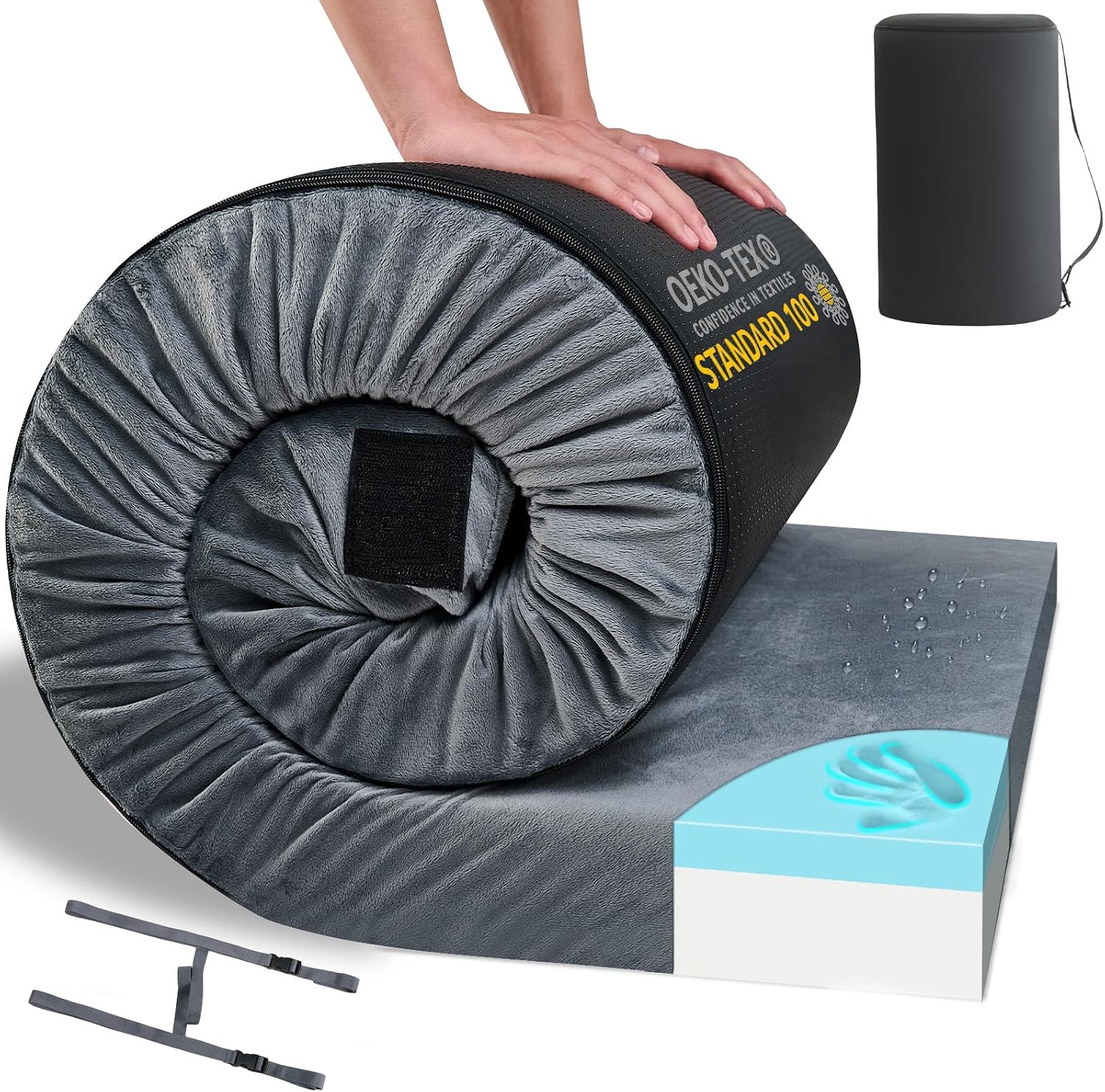
HomeMate Memory Foam Camping Mattress Pad: Portable Car Sleeping Pad
The name is unusually direct, which I appreciate: memory foam, camping mattress pad, and a car-first shape. Memory foam is the slow-recovery stuff that conforms under body heat, which is exactly why it feels good in a guest room and why some sleepers find it warm in a tent in July. The car framing matters too. A pad cut for a back seat or a wagon floor tends to be wider and flatter than a tapered backpacking pad, and that is the shape you want if the pad is going to double as a spare bed.
What I would verify before buying: stated thickness in inches, whether the cover comes off for washing, the rolled or folded footprint, and whether the base has any grip at all. If the listing will not state thickness, that tells you how seriously to take the rest of it.
Flaws but not dealbreakers: memory foam is heavy for its thickness and slow to re-expand after a week rolled tight. Give it a day to come back before you judge it.
Anyone sleeping in a vehicle, or hosting guests on a floor twice a year, gets the most out of this one. Check current Amazon price.
Tent-floor pick: Roll Up Foam Camping Mattress – 30D High-Density Foam Sleeping Pad with Travel Bag – Portable Floor Mat for Tent, Car Camping & Guest Bed
Tent-floor pick
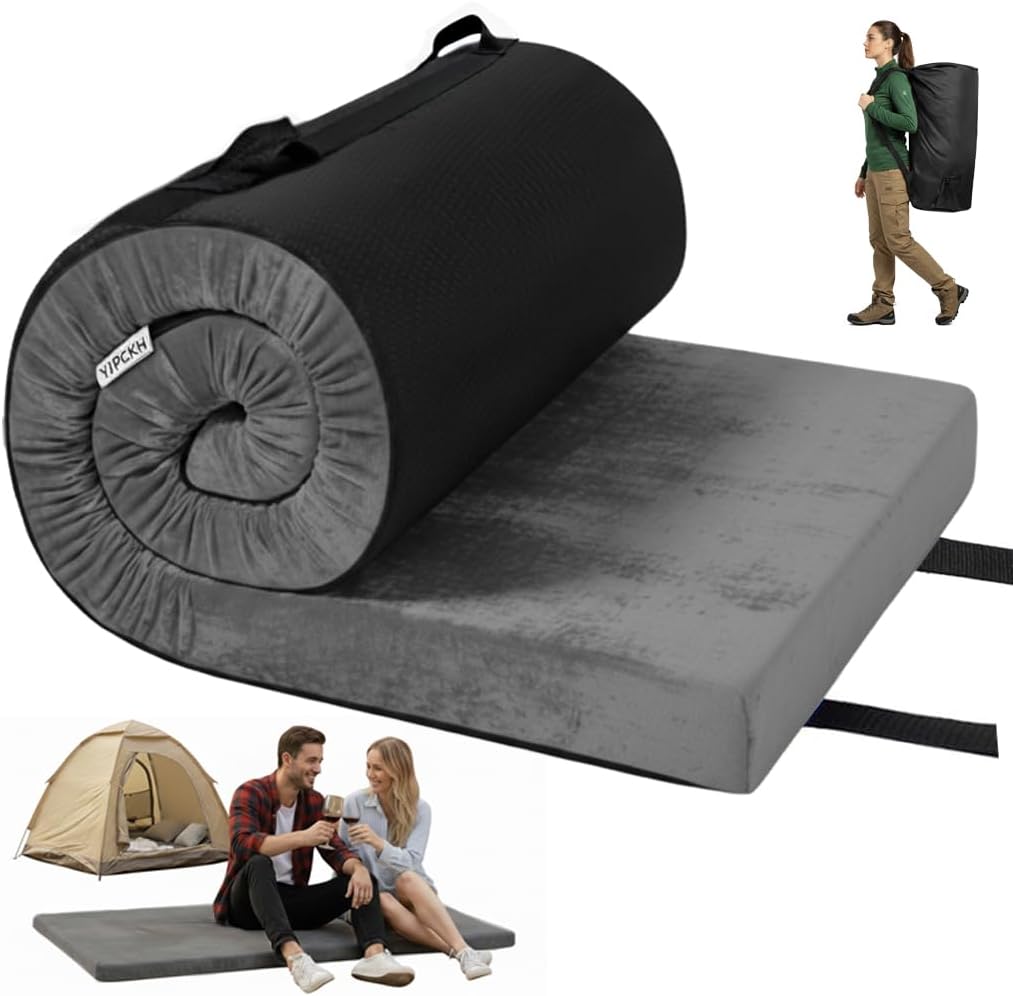
Roll Up Foam Camping Mattress – 30D High-Density Foam Sleeping Pad with Travel Bag – Portable Floor Mat for Tent, Car Camping & Guest Bed
The one number in that title is the one I want: 30D high-density foam. Density is the figure that predicts how long a foam slab keeps its shape, and a stated grade at least tells you the maker knows the vocabulary. It also ships with a travel bag, which sounds small until you have wrestled an unbagged roll into a trunk with one hand.
The roll-up format is the old, reliable one. No valve, no puncture risk, nothing to fail at two in the morning except your patience while rolling it. For a tent floor, a car camping base layer, or a floor mat that lives in a closet between trips, that simplicity is the whole argument. A Foam Sleeping Mats size guide always starts here: match the pad's length to your height plus a little, and its width to how much you move.
What to check: thickness, rolled length against your trunk or pack, whether the foam is a single slab or laminated layers, and whether the cover is removable. Laminated foam is where delamination complaints come from.
Flaws but not dealbreakers: a dense slab is not light, and rolling it tight enough for the bag takes practice. The bag is the weak point on almost every pad in this class.
This is the one I would hand a first-time car camper. Check current Amazon price.
Cot pick: Uniqwamer Thick Camping Sleeping Pad – Double Side Ultra Soft & Non-Slip Sleeping Mat with Portable Roll up Camping Cot Pad for Travel Car Tent Guest Bed
Cot pick
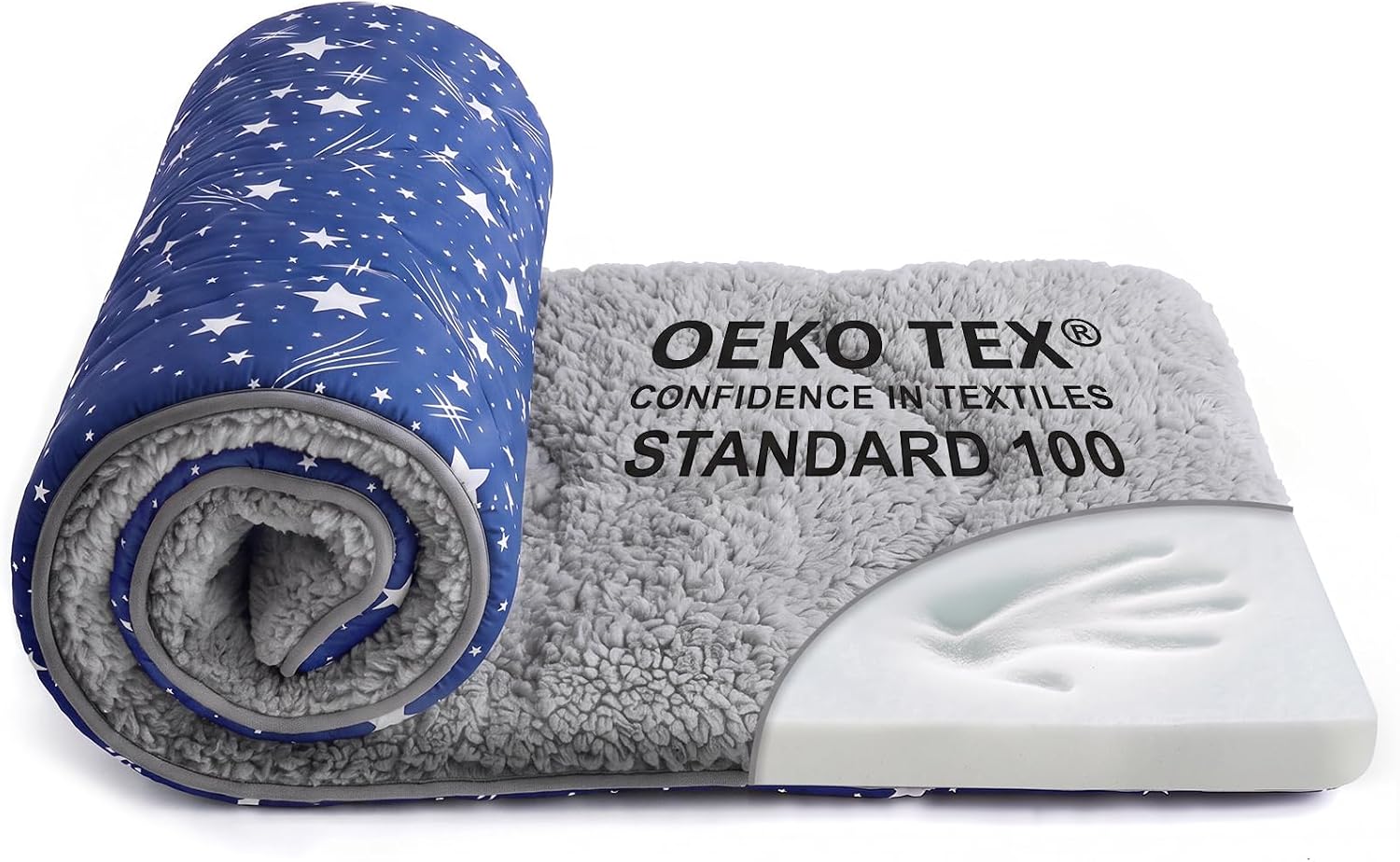
Uniqwamer Thick Camping Sleeping Pad – Double Side Ultra Soft & Non-Slip Sleeping Mat with Portable Roll up Camping Cot Pad for Travel Car Tent Guest Bed
Double-sided is the feature that earns its place here. One face softer, one face grippier is the right idea for a pad that has to sit on a tent floor one night and on a cot the next, and the non-slip side matters more than people expect. Cot fabric is slick, and a sliding pad wakes you up more reliably than a hard floor does.
The cot framing in the name is the honest signal. Cot pads want to be flatter and less tapered than backpacking pads, because a cot has a defined rectangle and anything wider hangs off the edge.
What to check: which face is which, the stated thickness, whether the non-slip side is a coating or a textured fabric, and the rolled diameter. A coating wears; a texture lasts. This one also sits at the bottom of the three on price, which makes it the natural starting point for a best budget Foam Sleeping Mats shortlist.
Flaws but not dealbreakers: "ultra soft" is a comfort word, not a specification. Chase the thickness number instead, and expect the pad to feel firmer than the marketing suggests when it is cold.
Good for cot sleepers, guest beds, and anyone who wants the entry point. Check current Amazon price.
The actual buying workflow
This is the order I run it in. It works whether you are buying your first pad or replacing one that flattened out.
Step one: Name where the pad lives. Tent floor, car back, cot, or guest room. Each one wants a different shape. A tent pad can taper; a car pad cannot. Write the answer down before you open a single listing, because the filter you need is different for each.
Step two: Measure the space, both ways. The sleeping area you will actually occupy, and the spot in the trunk, closet, or pack where the rolled pad will sit. This is where most people stop when they choose foam sleeping mats, and it is where most returns begin. Two numbers, taken with a tape, save the whole exercise.
Step three: Demand the thickness in inches. Not "thick," not "extra thick." For a tent floor, roughly two to three inches is the useful range for an adult. Under that you feel every pebble; well over that and the roll gets big enough that you stop carrying it.
Step four: Find the foam grade or density. A stated density means the maker is buying foam to a spec instead of guessing. Higher density holds shape longer and weighs more. If the listing lists neither density nor grade, assume the foam is whatever was cheapest that month.
Step five: Check the cover and the base. A removable, washable cover roughly doubles the usable life of a foam pad. A textured or coated base keeps the pad where you put it. A pad with neither is a pad you will be re-rolling at 3 a.m. on a slope.
Step six: Read the failure pattern, not the star average. Sort the reviews to the two-star and three-star entries and look for repeats. Seam splits, chemical smell on first unroll, foam flattening under a heavier sleeper, and a strap that tears off the bag. One complaint is noise. Four is a design.
Step seven: Weigh it against your carry plan. A foam pad that never leaves the car can be heavy. One that goes into a pack cannot. Be honest about which of those you are, because the wrong answer here is how a good pad ends up in a closet.
Step eight: Test it at home before the trip. Unroll it, let it sit a full day to expand, lie on it for twenty minutes, and roll it back into the bag. If it will not go back in, you have found out on a Tuesday instead of at a campsite in the rain. Foam Sleeping Mats for beginners rarely fail on the floor. They fail on the repack.
The competition and why it lost
Air pads pack smaller than anything here and win on weight every time. They also puncture, they crinkle, and a baffle failure at altitude leaves you on the ground with nothing. For a backpacker counting grams, that trade is correct. For a car camper sleeping twenty feet from a trunk, it is paying for a problem you do not have.
Self-inflating pads sit between the two: a foam core inside an air chamber. They are comfortable and they pack reasonably, but the valve is now the failure point and the foam inside still compresses over years. I like them for three-season backpacking and I do not recommend them as a guest bed that gets used four nights a year, because a pad that sits deflated in a closet is a pad whose valve you find out about too late.
Closed-cell accordion mats are bombproof and cost almost nothing. They are also about half an inch thick, and no amount of clever folding makes half an inch feel like a mattress. Great as a base layer under another pad, poor as the only thing between you and a tent floor.
Memory foam toppers sold for house beds lose on size. They are wide, they do not roll small, and a queen topper in a two-person tent is a joke nobody laughs at.
The category that lost hardest is the one that never states a number. Thickness, foam grade, weight, rolled size: if a listing gives you softness adjectives and no dimensions, it has told you what it is.
What this all costs
None of these three pads is a major purchase, and they sit close enough together in price that cost should not be your deciding factor. What separates them is shape and stated spec, not budget. Check current Amazon price on each before you commit, because listings move and I would rather you see the live number than a stale one.
The way to think about the spend is per night. A pad that lasts four seasons of car camping and gets used twenty nights a year costs you very little per night, and it replaces a motel room or an uncomfortable sofa. A cheap pad that flattens in one season costs more per night than the expensive one you were avoiding, because you buy it twice.
Two costs people forget. First, the bag: a pad whose stuff sack splits means buying a replacement sack or a strap, so factor a few dollars for that. Second, storage space. A thick foam pad needs a spot where it can stay unrolled or loosely rolled. If it lives compressed in a closet for eleven months, it will not come back to full thickness when you need it, and that is a cost you pay in comfort rather than cash.
My advice is boring and it works. Measure your space, make the listing state the numbers, pick the shape that matches where you sleep, and test the repack at home. Do that once and the pad outlasts the tent.